 Security ScanningNew + improved · included on every plan
Graded against what you wrote.
Every result is measured against the clause in your own policy, linked to it for you, and sealed as evidence the moment it lands. A fix closes only when a separate rescan says it held.
When a check and a clause map to the same control, and the platform is in the clause’s scope, we link them and the result counts. Each link says why. Clause owners can unlink any of them, and that’s on the trail too.
A pass rate isn’t a grade.
The same 68 checks, graded two ways. Flip it.
Most scanners grade against their checklist. Ours grade against yours.
If we can’t see it, it doesn’t pass.
When a platform refuses us, the result is not evidenced, with the reason. It never counts as passing, and it never quietly drops out of the total. Your pass count goes down instead of pretending.
Exceptions work the same way. A declared exception shows to your auditor as declared, and when it expires, the finding comes back on its own.
Bring our scanners. Bring yours. Bring both.
Native scanners on the platforms you run, plus import adapters for the tools you already trust, including CISA’s ScubaGear. Every result keeps its origin, so an imported report is never dressed up as a live reading, and a pentest finding stays point in time.
A fix closes on a rescan, not a click.
Every failing result arrives with its fix wired to the system it belongs to: an API change, a pull request, guided steps or a ticket. You approve it once. The service that applied it never gets to mark it done.
Sprinto’s Autonomous Trust Platform remediates and keeps an action log. A log says what was done. A passing rescan says it worked, and that’s what closes the finding here. If it didn’t hold, the change is rolled back.
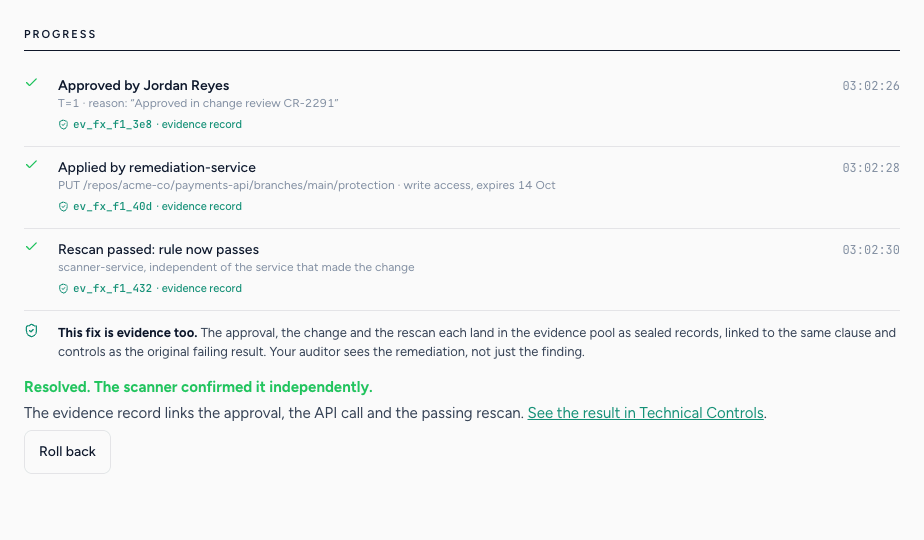
Sealed is not the same as sound.
Every result is sealed the moment it lands and timestamped by an outside authority, so your auditor can check nothing changed, without our help. Most platforms keep evidence in their own database, so trusting the record means trusting the vendor.
The Evidence Graph checks the harder thing: whether the record was right when it was written. A reading taken with a revoked token seals perfectly, and still gets caught. How the Evidence Graph works →
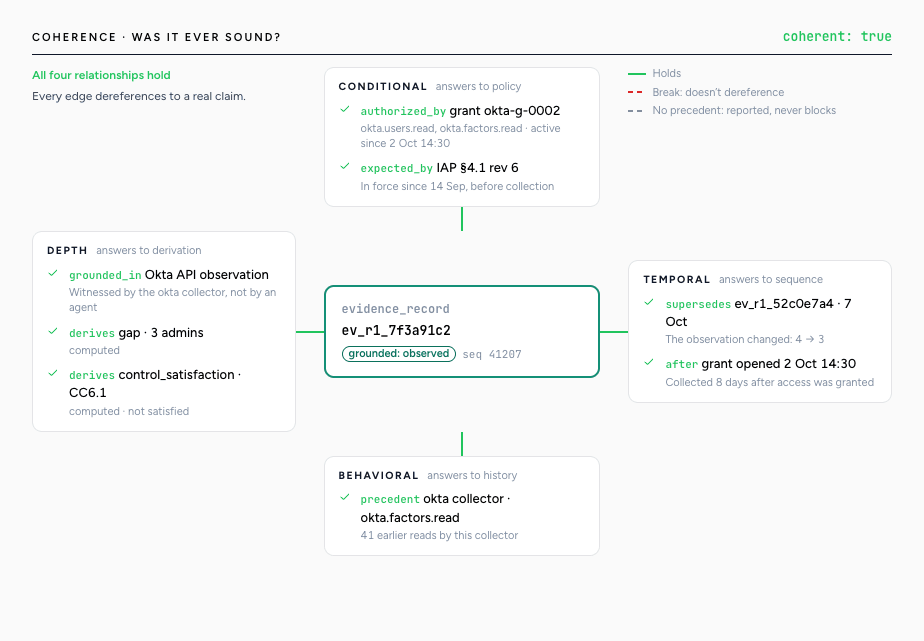
83 checks that can’t run are one problem, not 83.
When results can’t be collected, they roll up by cause. Most of the time it’s a permission on a connection, and fixing it once brings them all back. Try it.
Graded once. Counted everywhere it applies.
A result doesn’t stay in a scanner tab. It lands in one evidence pool, graded by one rule. Your policy shows which clauses it proves, and Assessments reads the same pool, so SOC 2 and ISO 27001 move together. The number on your posture page is the number your auditor sees.
Related reading
Compliance
GRC Software: 2026 Buyer’s Guide
Compare GRC software for 2026: six platforms across the platform-augmented, mid-market and enterprise tiers, in one buyer’s view.
Read the guide →Graded against what you wrote.
Scanning measures every result against your own policy, and keeps the proof that each fix held.