 EnforcementNew · included on every plan
Your policy says it. Now it happens.
Enforcement reads every requirement in your policies and makes each one run. A scanner checks it, or a named person does it on schedule. Either way, there’s proof.
“Access to production is reviewed every quarter by each person’s manager.”
Approved isn’t the same as running.
The same 20 policies, read two ways. Flip it.
Most platforms stop at the policy. We start there.
Graded against your numbers, not ours.
Every check reads the value in your own clause. Change the policy and the grades follow. A draft change waits until it’s approved, so results never move ahead of the policy.
Vanta lets you adjust a parameter on some of its tests, but you set it in the test, away from your policy, and nothing keeps the two in step.
Process controls run themselves.
An access review opens on its own date, pulls fresh account lists from your connections, and sends each account to the holder’s manager. Sign-off seals the lot.
Vanta, Drata and Secureframe have access reviews too. The difference is that this works for every process your policy describes, like backup restore tests and tabletop exercises, not only access.
Nobody leaves a control behind.
Your directory syncs from Okta, Entra ID, Google Workspace or BambooHR. A planned leave opens the handover before the person goes. A sudden one makes their named backup the acting owner the same day.
In Drata, when a policy owner loses access, their policies go to the first available admin. Here they go to the person who already agreed to cover them.
Done means a rescan passed.
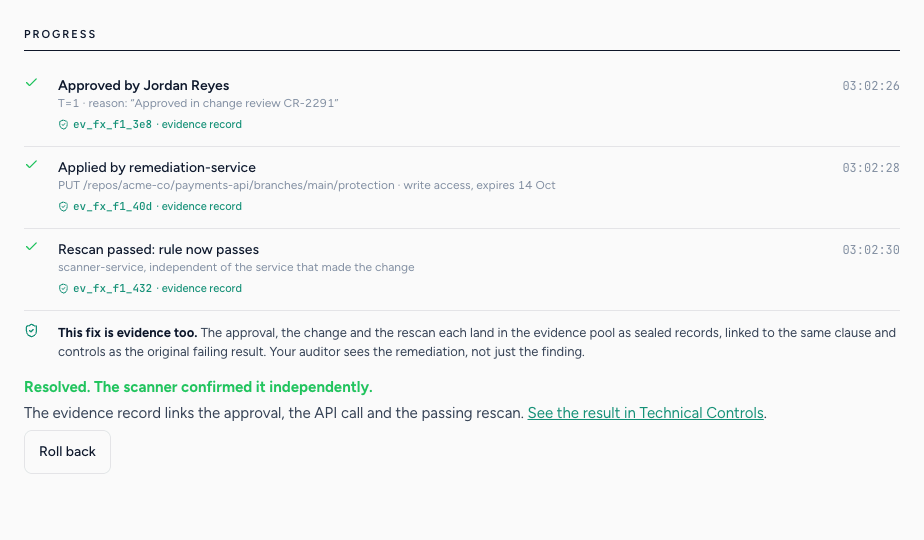
You approve a fix once. The service that applied it never gets to mark it done. A separate rescan does. If the change didn’t hold, it’s rolled back and the finding reopens.
Sprinto’s Autonomous Trust Platform also fixes things for you, and logs what it did. We keep the proof that it worked: the approval, the change and the passing rescan, each sealed as evidence. Each record is timestamped outside us and checked against the grant and policy version that produced it, so your auditor can verify it without our help. How the Evidence Graph works →
Fixes go where your engineers already work.
Not every fix can be applied for you. The ones that need an engineer land in your work management systems with the fix attached, and the right people hear about it in Slack or Teams. When the ticket is marked Done, we rescan. The finding closes only if the rescan passes. If it doesn’t, the ticket reopens with the reason.
AI drafts. A named person signs.
Draft a standard from your clause in seconds. It doesn’t take effect until a person approves it, and their name goes on the version. Scanner results are graded by rule, never by a model.
Vanta and Sprinto draft with AI too. Here, every version records who approved it, and an author approving their own draft is labelled as such.
Related reading
Compliance
GRC Software: 2026 Buyer’s Guide
Compare GRC software for 2026: six platforms across the platform-augmented, mid-market and enterprise tiers, in one buyer’s view.
Read the guide →Approve it once. Then watch it run.
Your policies say what should happen. Enforcement makes sure it does, and keeps the proof.