A 312-question security review just landed. The deal closes Friday.
Most of the answers are things you’ve already proven. Approve those together, send the rest to the people who know, and ship every answer with a link the buyer can check without emailing you. The questionnaire stops being the thing the deal waits on.
How you answer the questionnaire is the first thing a buyer learns about the culture of your business
From “we’ll get back to you next week” to “answers by end of day.”
Four problems that block anyone fielding these — sales, security, or the founder wearing both hats — and what changes on the platform.
You’re not behind. You’re here.
No SOC 2 yet, no policies to point at, nothing to draft from. That’s every company’s first enterprise deal, and buyers know it. In three steps you go from nothing to a questionnaire you can send by the deadline.
Know on Sunday whether you’ll make Wednesday.
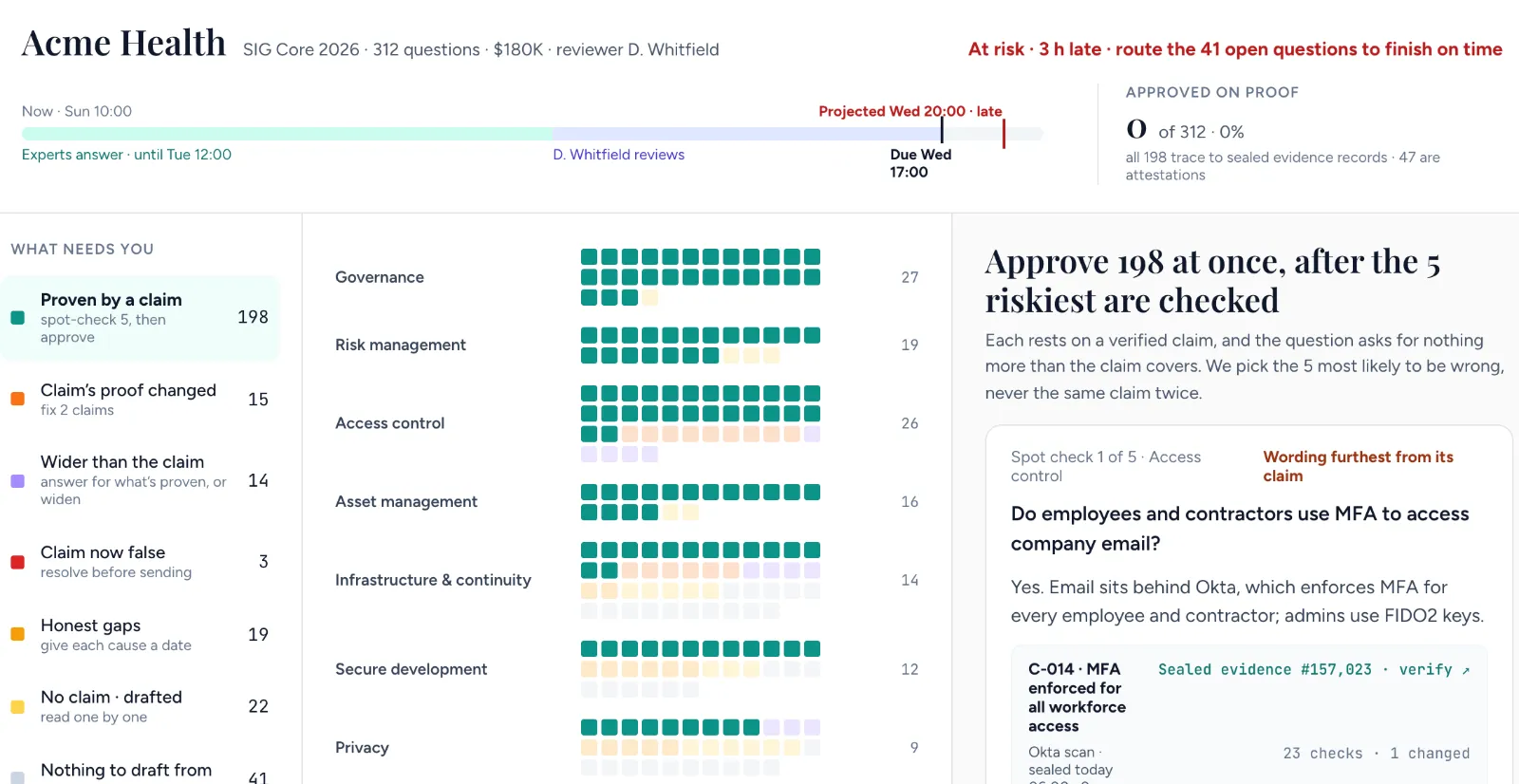
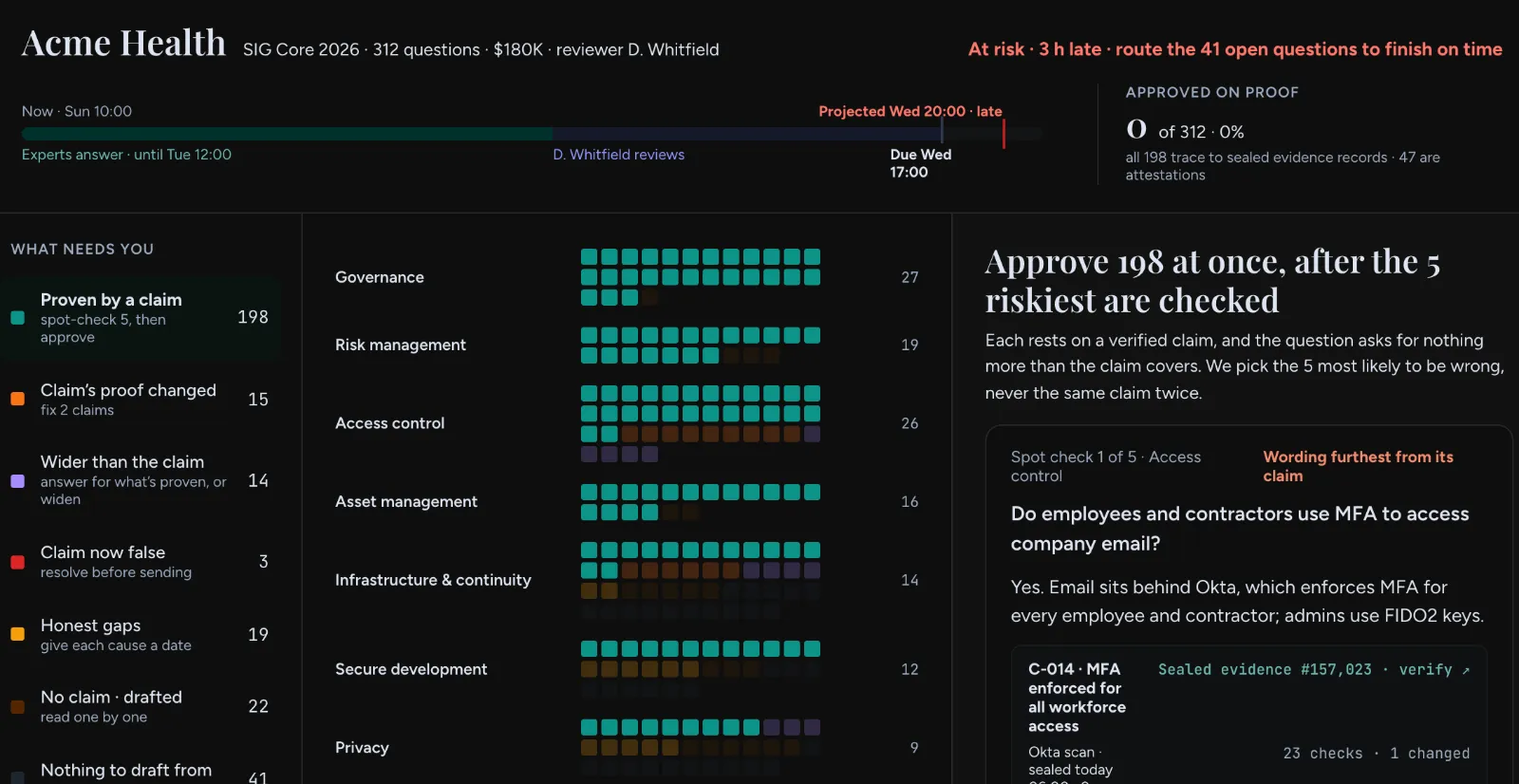
Upload the spreadsheet, PDF or Word doc procurement sent. Every question is matched to what you’ve already proven, grouped by what it needs from you, and timed against the buyer’s deadline. If it’s going to be late, you see it in time to do something about it.
- The proven ones, approved together. You check five, picked as the most likely to be wrong. The rest go in one step.
- The rest, sorted by what they need. Proof changed, wider than the claim, claim now false, gaps, drafts to read, and questions nobody has answered yet.
- Open questions go to their owners as one job, with the projected finish against the due date.
- Any format back out. SIG Lite, SIG Core, CAIQ, HECVAT, VSAQ or the custom spreadsheet, exported in the buyer’s template.
The buyer checks it themselves. No follow-up round.
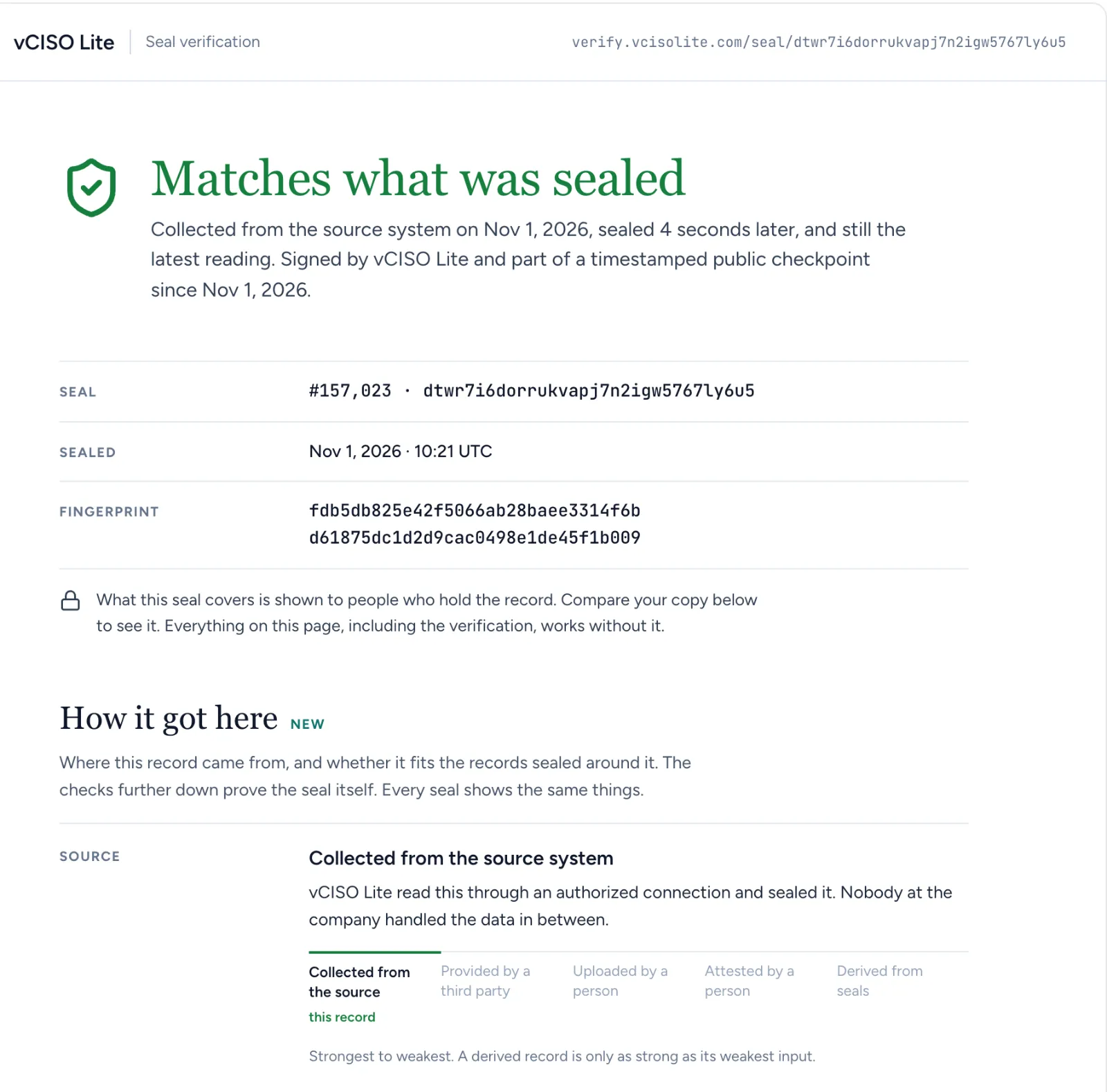
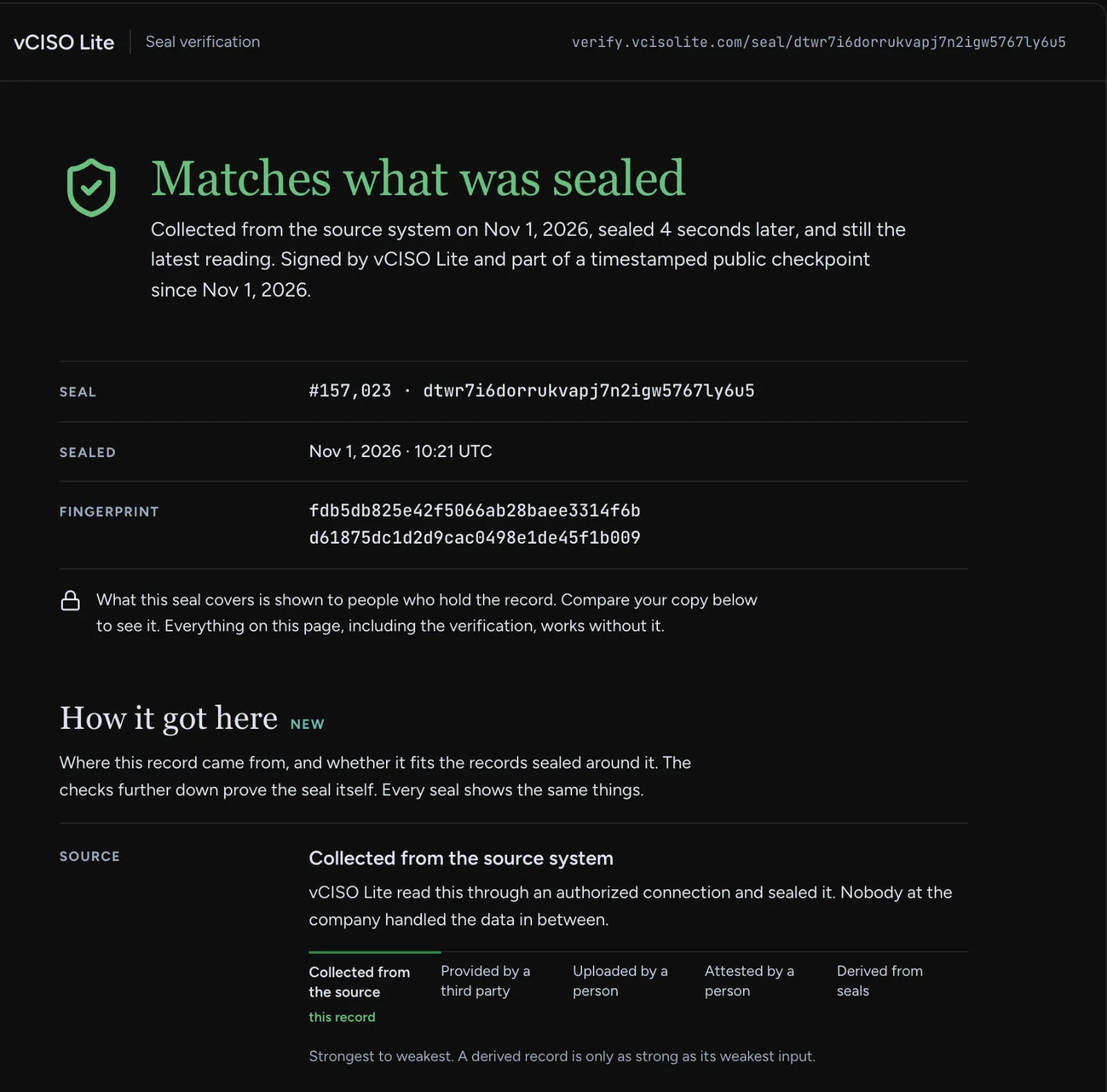
The follow-up email is where deals lose a week: “can you send the policy, the access review, the audit report?” Here, each answer carries a link to a sealed record. The buyer opens it, sees it matches, and moves on. They don’t need to trust us or you, only the math.
- No sign-up on their side. The buyer opens the link from your answer and sees whether it matches what was sealed, when, and from where.
- The kind of proof is labeled. Collected from the source, provided by a third party, uploaded or attested by a person. Nothing is dressed up as more than it is.
- Fewer questionnaires, with your Trust Center. The same claims go on a public page you point buyers to, each statement linked to its verify page. A buyer who can read and check it often skips the spreadsheet. See what’s new in Trust Center →
Take security off the critical path. Keep deals moving.
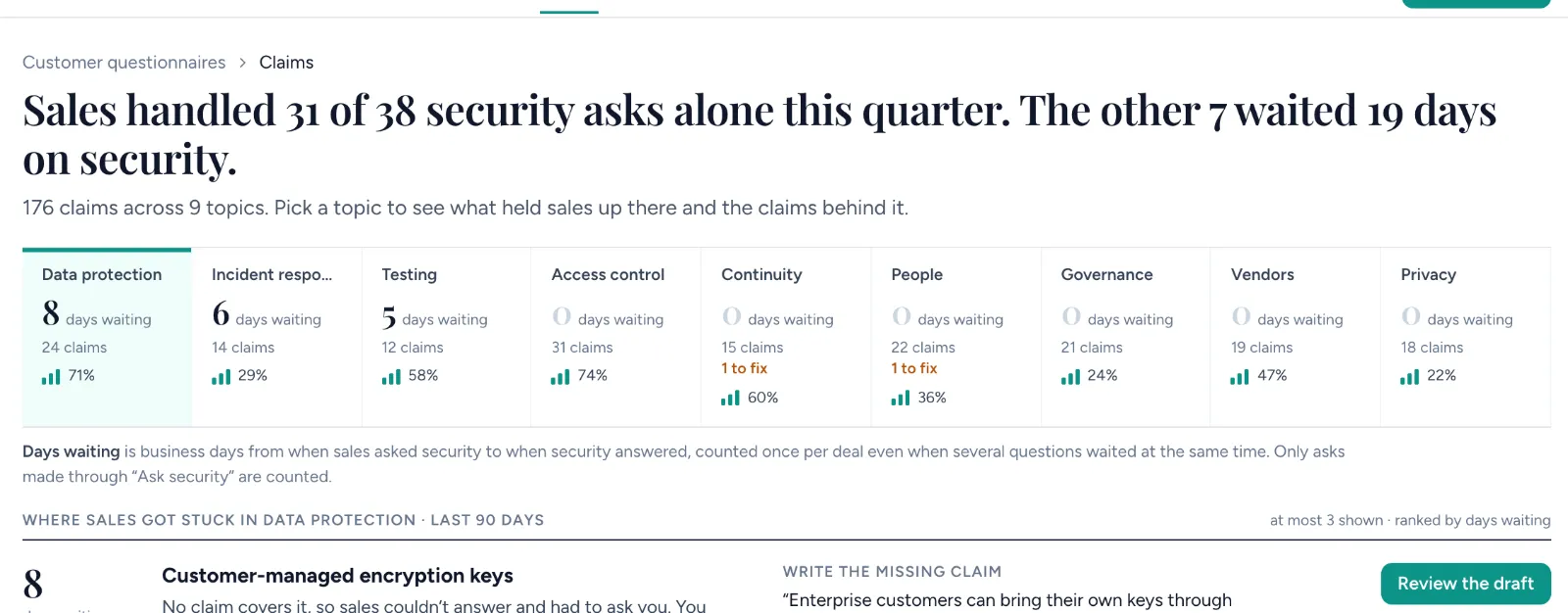
Every questionnaire you answer leaves proven answers behind. The next time a buyer asks, sales replies the same day without waiting on security, and security spends its time on the questions that are genuinely new. When something does hold a deal up, you see which topic and for how long, and fix it once for every deal after.
Wednesday inbox drop, Friday signature.
The questionnaire didn’t slow the deal down.
Four things that have to be true together.
Any one of these on its own is an answer library. All four together is a response the buyer’s security team accepts.
Answer provenance
Every answer traces to the claim behind it, and the claim to the sealed record that proves it. When the buyer asks “where did this come from?”, the answer is one click away.
Evidence attached inline
Policies, access reviews and audit-report excerpts ship with the answer, not in a follow-up email a week later. Every record is sealed, timestamped and checkable.
A library that keeps itself current
Every approved answer becomes a claim. When the proof behind one changes, it’s flagged everywhere it was used, so the next questionnaire starts from what’s true now.
Cross-mapped to your frameworks
The MFA claim that answers a SIG question also answers the CAIQ one, and satisfies SOC 2 CC6.1 and ISO 27001 A.9.2.3. One source of truth, every questionnaire.
Rather not deal with it at all?
Other20 advisory completes questionnaires for you, including the ones that live inside a buyer’s procurement portal and can’t be uploaded anywhere.
See advisory services →COMMON QUESTIONS
Security questionnaire questions
Which questionnaire formats does this handle?
SIG Lite, SIG Core, CAIQ Lite, CAIQ, HECVAT, VSAQ, and custom spreadsheets, PDFs or Word documents. Answers export back in the buyer’s template.
What if a question isn’t covered by anything we’ve proven?
It’s flagged rather than invented. If there’s related evidence, a draft is written for you to read. If there’s nothing, it goes to the person who would know. Once you answer, it becomes a claim for next time.
How does the buyer verify an answer?
Each answer that rests on a sealed record carries a link to a public verify page. It shows whether what they hold matches what was sealed, when it was collected and from where. No sign-up on their side.
How is this different from Loopio or SafeBase?
Answer libraries store what you said last time and help you find it. Here, answers come from claims tied to live evidence from your compliance program. When the evidence changes, the claim notices.
Can sales use it without bothering security?
Yes. When a claim covers the question, sales can answer it directly. When it doesn’t, the ask goes to security and is counted, so you can see where sales got stuck.
What about questionnaires inside a buyer’s procurement portal?
Our Other20 advisory team completes those for you.
Don’t lose the deal over a questionnaire.
Answer from what you’ve already proven, and send every answer with a link the buyer can check.