Field note · Incident study
The Championship Ring Was the Bait.

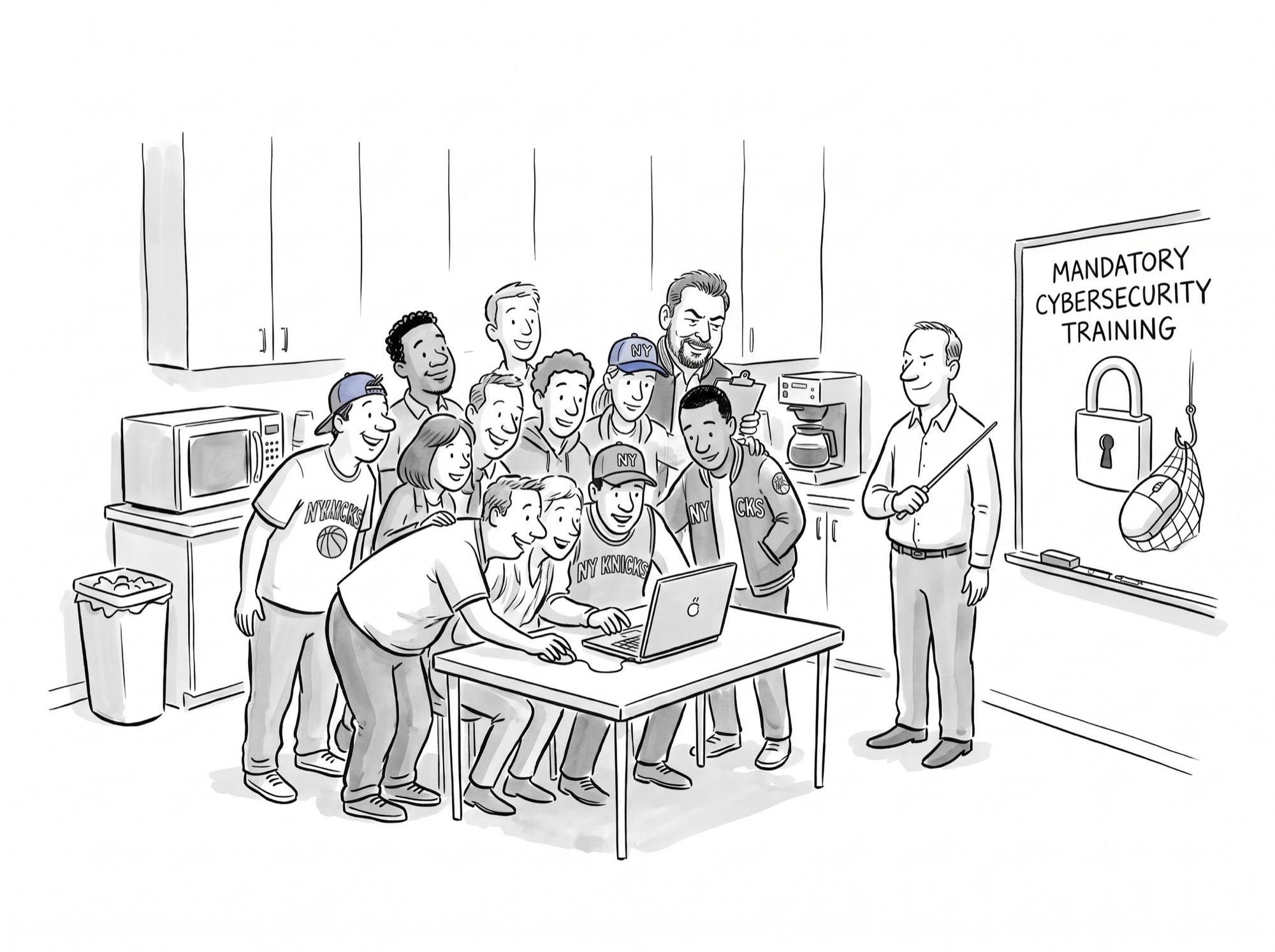
On Tuesday, October 20, 2026, the New York Knicks handed out championship rings before their home opener against the 76ers. Their first title in fifty-three years. Around the same time, Madison Square Garden employees received an email with two differently styled rings at the top and an invitation to pick one. The employees who clicked did not get a ring. Per team sources, they were sent to a mandatory cybersecurity class. The Athletic’s Joe Vardon reported on Thursday that the test was meant to help satisfy owner James Dolan’s “growing cybersecurity concerns.”
The coverage is playing it as a cruel prank. I read it differently. Early in the NBA Finals, an attacker phoned a low-level MSG employee, talked them out of their credentials, and walked into the company’s identity platform. Three days after the Knicks clinched, the stolen data was on the internet. Ten months before that, a vendor-hosted Oracle system had leaked names and Social Security numbers from MSG’s hiring and payment records. The concerns were earned, and the bait was a reasonable read of the threat. What deserves the scrutiny is what the test actually measured, and which of the two breaches it could ever have touched.
Why Dolan’s cybersecurity concerns were real
James Dolan has run Madison Square Garden’s sports properties since 1999, and for most of that stretch he was the owner Knicks fans blamed. On June 13, 2026, the Knicks beat the Spurs 94–90 in Game 5 and won their first title since 1973. Dolan’s message to the city was an apology: “I’m sorry it took so long. But here we are.”
Three days later, his company’s data was on the internet. The intrusion had started on June 5, three days into the Finals, with a phone call to one employee. What came out was 9.8 million customers’ email addresses, the home addresses of former players and celebrities, and the logs of the facial-recognition entry system Dolan personally went on television to defend in 2023 as a security tool. Sitting next to those logs was a document profiling three of that system’s public critics. The first class action, filed the next day, went straight at the program.
And it was the second time. Ten months earlier, files of names and Social Security numbers from MSG’s hiring and payment records had walked out through a vendor’s Oracle server. Those are records about the people MSG employs and pays. By the summer of the championship, every layer the owner could point to had failed in public: a vendor’s server, the company’s own identity platform, and the surveillance system he had staked his name on. That is where “growing cybersecurity concerns” comes from.
Were those concerns well founded? The industry numbers say yes, on both counts. CrowdStrike’s 2026 Threat Hunting Report found that vishing intrusions doubled in the first half of 2026, the same half MSG was hit, with eCrime crews using phone calls to take over single sign-on accounts and, in one case, moving from account takeover to data theft in under five minutes. Verizon’s 2026 Data Breach Investigations Report found that 31% of breaches now start with a software vulnerability, overtaking stolen passwords as the most common way in. That is the shape of the August 2025 breach. Dolan was not being paranoid. He was looking at the two most common doors of the year, and both had already opened on him.
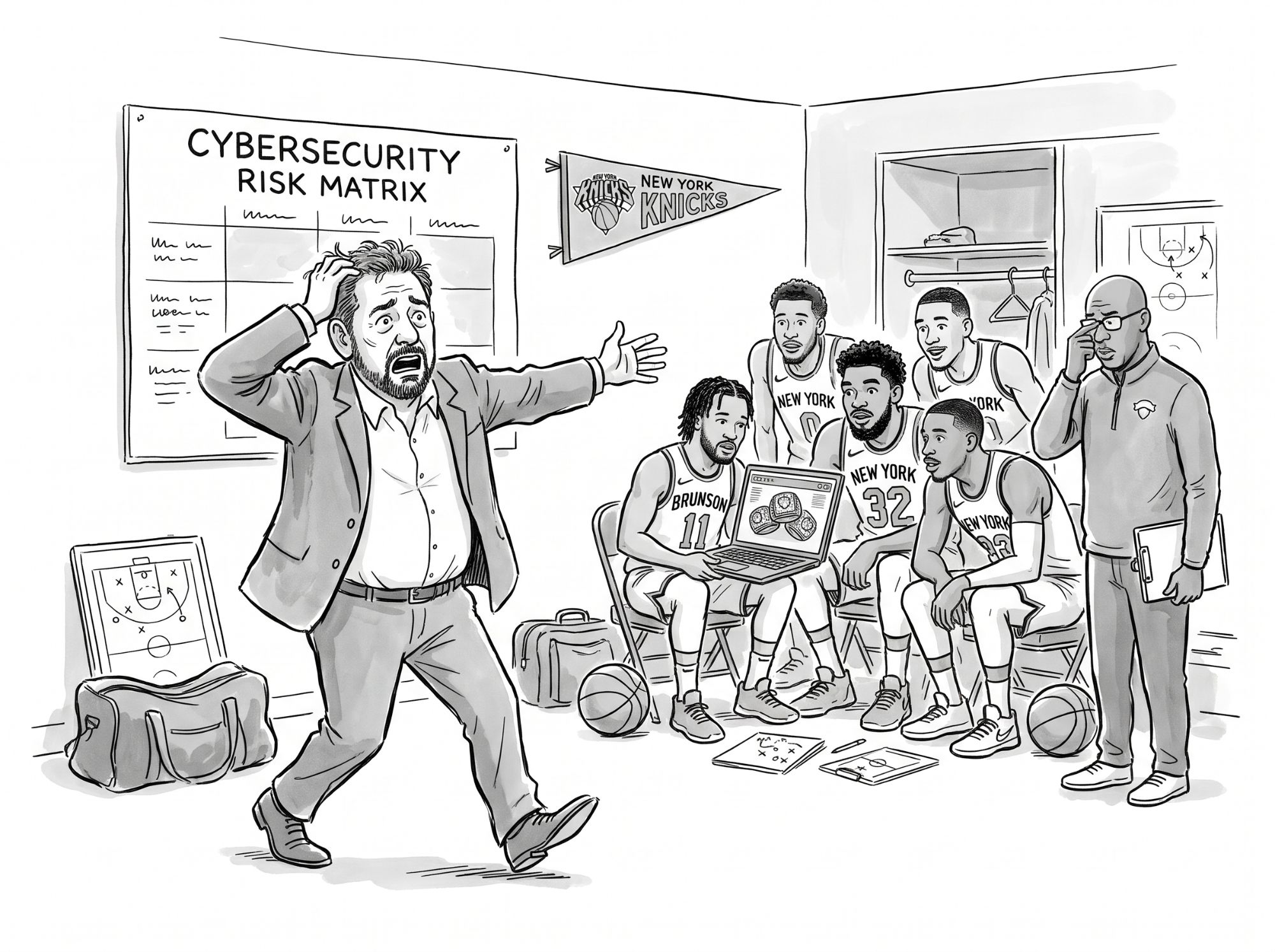
Why now? Phishing is older than most of the people it targets. What changed is where the access lives and who holds the key to it. Four shifts explain why a phone call to one employee is worth more to an attacker in 2026 than it was five years ago.
One login now opens everything. Companies consolidated their applications behind single sign-on, which is good for productivity and good for attackers. CrowdStrike describes intrusions that “now move through trusted identities, SaaS applications, and cloud infrastructure,” and its 2026 hunting data shows crews compromising SSO-connected SaaS apps specifically to exfiltrate data. MSG’s June attacker didn’t need to break anything. One set of credentials opened Microsoft Entra, and Entra opened the rest.
MFA moved the target from the password to the person. A stolen password alone is worth less than it used to be, because most logins now ask for a second factor. So the attacker stays on the phone while the victim completes it. Mandiant describes kits that sync the caller’s script with live MFA prompts, then “enroll threat actor controlled devices into victim multifactor authentication solutions.” Monthly device-code phishing attempts, another way to get a person to approve a login for someone else, rose 15× in the first half of 2026.
Email got filtered. Phones didn’t. A decade of investment went into scanning inboxes. Nothing scans a phone call. As Halcyon’s Cynthia Kaiser told CyberScoop, voice reaches people where they “don’t necessarily have their guard up.” An employee who has been trained for years to hover over links has rarely been trained to hang up on someone who sounds like the help desk.
The clock collapsed. In one 2026 incident CrowdStrike tracked, a crew went from account takeover to data theft in under five minutes. When the gap between one bad phone call and a public leak is that short, wanting to know how your employees handle the phone is the obvious move.
AI-enabled adversaries increased operations by 89% year over year. “AI is compressing the time between intent and execution.”
— CrowdStrike 2026 Global Threat Report, February 24, 2026
The record, in six dated events. Two different attackers, two different doors, and one of them opened by a person on the phone.
August 2025 · vendor-hosted Oracle EBS accessed
An unauthorized party reaches data in MSG’s Oracle E-Business Suite, a system MSG’s own notice letter describes as “hosted and managed for us by a vendor.” The flaw is CVE-2025-61882 (CVSS 9.8), a zero-day in EBS Concurrent Processing that Oracle does not patch until October. No employee does anything wrong. There is nothing for an employee to click.
Nov 2025 – Mar 2026 · Cl0p claim, 210 GB leak, SSN notices
Cl0p lists MSG among more than 100 organizations hit through the EBS campaign and, after MSG reportedly refuses to pay, leaks more than 210 GB of archived files. The investigation concludes in late November. Notice letters follow: files of business records tied to hiring and payments to individuals, containing names and Social Security numbers. MSG offers a year of credit monitoring. Hiring and payment records are records about the people MSG hires and pays.
June 5, 2026 · mid-Finals, one phone call
The NBA Finals opened two days ago. Per 404 Media’s sources, an attacker voice-phishes a low-level MSG employee and socially engineers them into handing over credentials. Those credentials open Microsoft Entra, the identity platform behind MSG’s corporate network. ShinyHunters claims the intrusion. This is the playbook the group and its affiliates have run across dozens of companies: call an employee as IT, steer them to a look-alike sign-in page, capture the password and the MFA code.
June 15–16, 2026 · ransom deadline passes, 45 GB published
The Knicks clinched on June 13. Two days later the ransom deadline passes and MSG does not pay. ShinyHunters publishes a 45 GB archive and claims more than 26 million records across MSG Sports, the Knicks, and the Rangers. A DataBreach.com engineer counts about 9.8 million customer email addresses, just under 5 million street addresses with names and phone numbers, and roughly 9,500 dates of birth. The archive also holds a “Talent” folder with home addresses and threat-assessment fields, logs from MSG’s facial-recognition entry system, and a SharePoint document profiling three public critics of that system. 404 Media’s Joseph Cox reviews the files and confirms they are real.
June 17, 2026 onward · class actions
The first class action lands the day after publication, alleging that biometric data captured from concertgoers was later exposed. More suits follow in the Southern District of New York. MSG declines to comment. At this point the company has two leaked datasets in the wild, SSN notices already mailed, and its facial-recognition program named in court.
October 2026 · the ring email
Employees receive an email with two ring designs and an invitation to choose. Clickers go to a mandatory cybersecurity class. Vardon reports it on October 22. The lure is built from the same event the June intrusion ran underneath: the championship.
What got in, and what the ring email measured
Read against the record, the ring test aimed at the right population and the right moment. It measured a different behavior than the one that failed in June, and it had no reach at all into the one that failed in August.
The concern was earned and the bait was realistic. The test measured the behavior that is easiest to measure, not the one that failed.
— Our read of the public record
From simulation to fire drill
A phishing simulation asks who clicked. A phishing fire drill asks how fast the organization responded. Many security teams have moved from the first to the second, and the difference would have changed almost everything about this story.
A simulation is unannounced, scored on click rate, and usually comes with a consequence for failing. The ring email is a textbook example. It told employees that the organization was finally including them in something that happens once every fifty-three years, then sent the ones who believed it to a mandatory class. That is a gotcha with a KPI attached.
A fire drill works the way a building evacuation does. Everyone knows drills happen. Nobody is disciplined for walking out the wrong door. The point is to rehearse the response until it is automatic, and the scores are the ones that matter during a real incident: how many people reported, how fast, and how long it took the security team to contain it.
A drill would have rehearsed the June failure. Run on the pattern that actually hit MSG, it looks like this. Someone calls during a big event claiming to be IT. The employee hangs up, calls the help desk back on a number they already know, and reports the call. The help desk refuses to re-enroll MFA on a phone request. The security team revokes sessions in the identity platform. The score is minutes from first ring to containment, which is the only number that counts against a crew that can move from account takeover to data theft in under five minutes.
The ring could still have been the lure. “This quarter’s drill uses an event-themed pretext” turns the championship into a lesson instead of a betrayal. Employees who don’t feel tricked don’t take the story to The Athletic.
It builds the trust the simulation spent. The people who clicked the ring email will tell their coworkers what it was. The next time anybody at MSG sees a legitimate note about a payroll correction or an open-enrollment deadline, the first instinct will be to assume it is another trick, and the next strange phone call is less likely to get reported to the people who could stop it. A drill rewards the report, which is the one behavior MSG most needs more of.
The tradeoff: announced drills flatter the results, because people perform better when they know a test is coming. Mature programs run mostly drills and a smaller number of unannounced tests, under the same no-discipline rule.
The policy and standards layer
A security awareness program is a process control. Process controls have policies, standards, named owners, and evidence that they ran. That layer is what turns an owner’s concern into a program instead of a single email.
The policy clause
Written in plain English, approved by a named signatory. Example wording: “Social-engineering drills run quarterly against the techniques used against us, including voice, and are scored on report rate and time to containment. A smaller number of unannounced tests run under the same rules. Pretexts that impersonate recognition, compensation, or benefits require sign-off from the program owner and the HR lead, and a failed test routes to a short just-in-time lesson and never to discipline.” That clause does not ban the ring email. It puts two names on it and changes what happens after the click.
The standard that implements the clause
A short document that says who runs the program, how often it runs, what the pretext catalog contains, who maintains it, how results are reported, and what the training workflow does when someone fails. It sits next to the standards that cover the June failure directly: call-back verification for anyone claiming to be IT, and no MFA re-enrollment on a phone request alone.
The cycle that runs on schedule
Opens on its own date. Pulls the pretext from the catalog. Routes a request to the approvers when a new one is proposed. Sends the measurement. Closes on the owner’s sign-off. Every step is on an audit trail that an auditor can read without the organization’s help.
What vCISO Lite would and wouldn’t have changed
The temptation is to claim a platform would have stopped both breaches. It wouldn’t. Here’s the split.
CVE-2025-61882 was exploited before Oracle shipped a patch. No customer-side program closes a window the software vendor has not closed yet.
A skilled caller on a busy night will sometimes beat a trained employee. Policy lowers the odds and shortens the damage. It does not make a person unphishable.
Whether a championship ring is fair game is a judgment call for the people who own the program. Software can require that someone makes it on the record. It shouldn’t make it for them.
Enforcement, which we shipped on October 20, turns each requirement in your approved policies into a standard that runs on a schedule with named owners. The drill clause above becomes a quarterly cycle with an approved pretext catalog and a sign-off, sealed on the Evidence Graph so an auditor can re-derive it.
Call-back verification and help-desk MFA re-enrollment rules are policy requirements like any other. In Enforcement they run as process standards with an owner and a cycle, so the question “would our help desk re-enroll MFA for a caller?” gets an answer with evidence behind it.
Our vendor-incident auto-declaration watches CVE databases, government advisories, and vendor disclosures across your vendor list. An Oracle EBS zero-day under active exploitation lands as a declared incident against the vendor hosting your instance the day it is public, not months later in a notice letter.
Our read
Three positions, in order of confidence.
One. Half of MSG’s record had nothing to do with employees, and that half is the one no awareness program can reach. The August 2025 breach ran through a vendor-hosted system and a zero-day, which is now the most common way into an organization according to Verizon’s 2026 DBIR. The fix for that lives in third-party patch cadence, vendor incident response, and knowing which vendors host what. None of it is visible to employees, which is exactly why it tends to lose the budget conversation to something that is.
Two. The ring was realistic bait, and the outrage misses that. The June intrusion ran underneath the Finals, while the whole company was watching basketball. The next one will pick a moment like that too. An event-timed lure aimed at employees is a fair reading of the threat MSG actually faced. Calling it a prank lets everyone skip the harder conversation.
Three. What failed was the follow-through, not the instinct. The June failure was a voice call and a surrendered credential, and the test measured an email click. Then it answered the click with a mandatory class, which teaches people to stay quiet the next time something feels off. Dolan’s concern was the right one. It needed a program to run through: a clause, a standard, an owner, and a cycle that tests the behavior that actually broke.
Primary sources
- ClutchPoints — Knicks’ James Dolan used fake scam email to employees (Oct 22, 2026, citing The Athletic’s Joe Vardon)
- Yahoo Sports — Knicks’ James Dolan used fake scam email
- The CyberSec Guru — ShinyHunters MSG breach: vishing vector per 404 Media, leak contents, first class action
- Security Boulevard — MSG Breach: Knicks Take the NBA Championship, ShinyHunters Takes the Data
- Wikipedia — 2026 NBA Finals (June 3–13; Game 5 clincher, 94–90)
- James Dolan says “sorry” to Knicks fans after winning the NBA championship
- Fortune — Dolan defends MSG’s facial recognition (January 2023)
- Have I Been Pwned — Madison Square Garden Sports breach entry
- databreach.com — Madison Square Garden Sports Corp. 2026
- Security Affairs — Oracle EBS 2025 campaign impacts Madison Square Garden (notice letter, CVE-2025-61882, Cl0p leak)
- Comparitech — Madison Square Garden warns of data breach that leaked SSNs
- CrowdStrike — 2026 Threat Hunting Report (Aug 3, 2026): vishing intrusions up 2× in 1H 2026
- Verizon — 2026 Data Breach Investigations Report: 31% of breaches start with a software vulnerability
- CrowdStrike — 2026 Global Threat Report (Feb 24, 2026): AI-enabled adversary operations up 89%
- CyberScoop — A new wave of vishing attacks is breaking into SSO accounts in real time (Jan 26, 2026)